Traditional Sink vs Smart Sinks: Australian Data Reveals a 10 to 1 Preference Gap
TikTok Trend vs. Real-World Reality: What Australian Search Data Reveals About Smart Sinks

Key Findings
For every 10-15 people interested in a stainless steel kitchen sink in Australia, only 1 (or fewer) is interested in a smart sink.
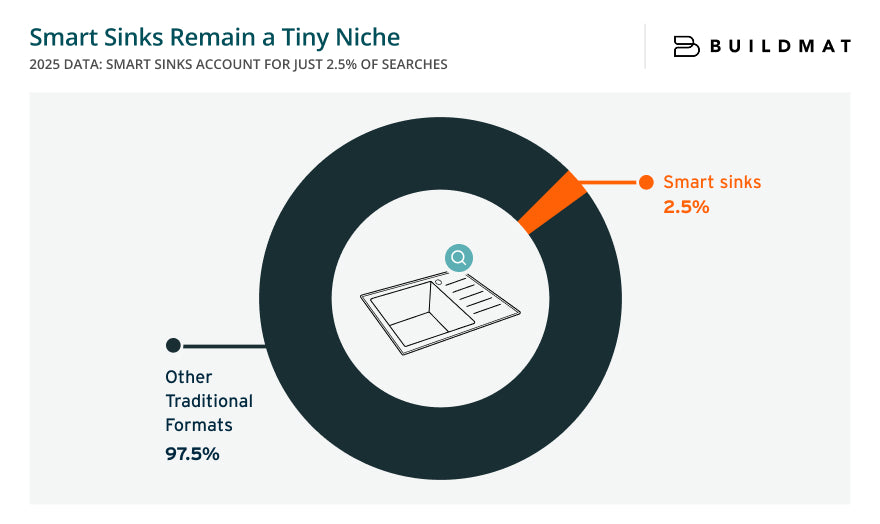
Despite generating social media buzz and YouTube demos, Buildmat’s analysis of aggregated data shows smart sinks represent just 2.5% of total sink-related searches in Australia. Meanwhile, interest in traditional options like stainless steel, single bowl, and double bowl sinks has grown strongly and consistently from 2020 to 2025.
Embed this chart to your site
Paste this code snippet into your website's source code or HTML editor to display the chart with a citation.
Our observed data is clear: smart sinks are a conversation piece while standard sinks are a commitment.
The Global Context: Stainless Steel Dominates a Growing Market
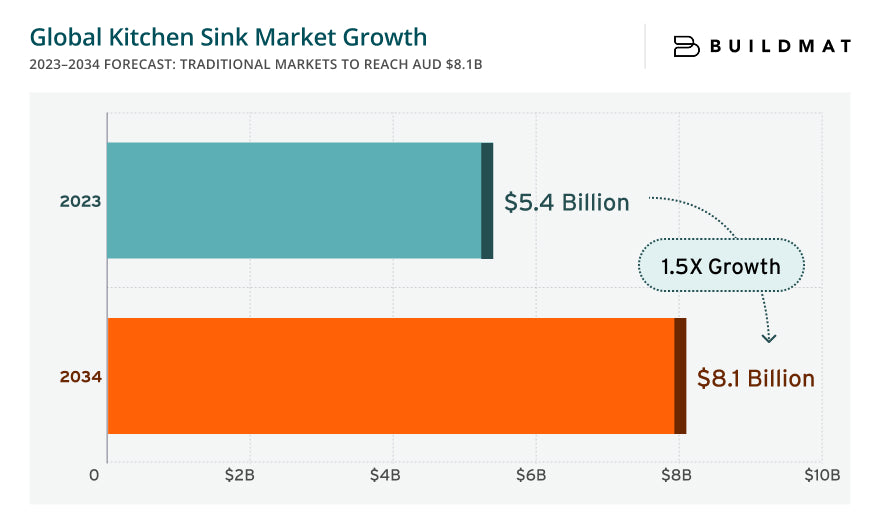
The global kitchen sinks market was valued at USD $3.6 billion (AUD $5.4B) in 2023 and is projected to reach USD $5.4 billion (AUD $8.1B) by 2034, growing at a 3.9% CAGR according to Allied Market Research's 2024 industry forecast. This growth is driven by home improvement trends, hospitality expansion, and rapid urbanisation, particularly in the Asia-Pacific region.
Embed this chart to your site
Paste this code snippet into your website's source code or HTML editor to display the chart with a citation.
What's driving this growth?
-
Metal sinks – especially stainless steel – dominate the market due to their strength, durability, affordability, and versatility
-
Single-bowl formats hold the largest market share globally
-
Leading brands include Kohler, Blanco, Elkay, Roca, and Oliveri
Against this backdrop of steady global growth in traditional sink categories, Australian data reveals exactly where renovators are focusing, and it's overwhelmingly on proven formats, not smart technology.
The Australian Market Reality: Traditional Sink Interest Wins by Massive Margins
Embed this chart to your site
Paste this code snippet into your website's source code or HTML editor to display the chart with a citation.
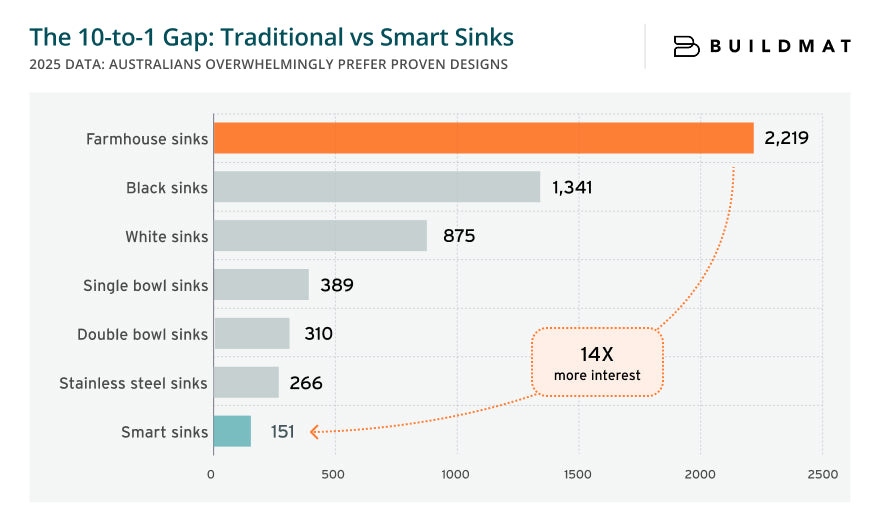
Search Volume Comparison (2025 Calendar Year Average)
Based on January - December 2025 Australian Google search data
-
Farmhouse sinks: 2,219 searches/month
-
Black sinks: 1,341 searches/month (9x more than smart sinks)
-
White sinks: 875 searches/month (6x more than smart sinks)
-
Single bowl sinks: 389 searches/month (2.6x more than smart sinks)
-
Double bowl sinks: 310 searches/month (2x more than smart sinks)
-
Stainless steel sinks: 266 searches/month (1.8x more than smart sinks)
-
Smart sinks: Only 151 searches/month
For every 10-15 people searching for a stainless steel kitchen sink, only about 1 is searching for a smart sink.
Smart Growth Has Stopped
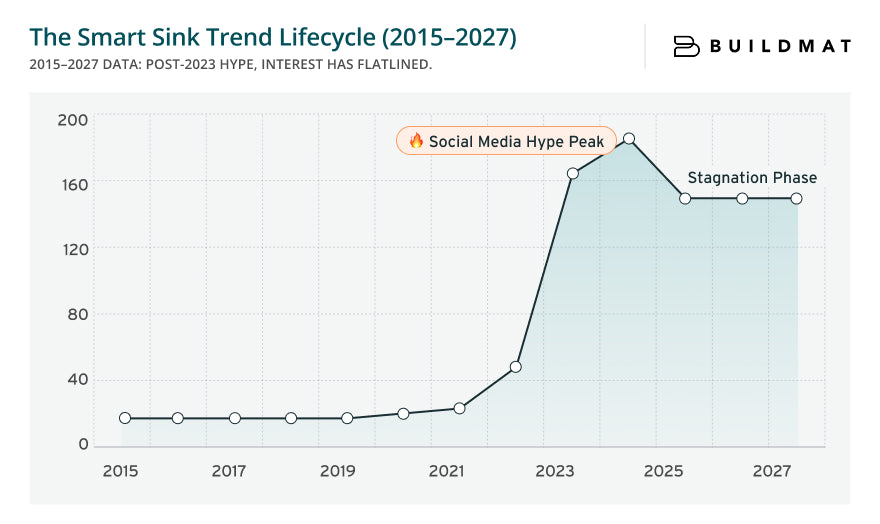
The search data reveals a pattern for smart sink manufacturers:
-
2015-2019: Flat at ~17 searches/month (essentially zero market interest)
-
2020: 20 searches/month (first small uptick)
-
2021-2022: Acceleration begins (23-48 searches/month)
-
2023: Peak interest at 165 average, with a spike to 400 searches in January 2023
-
2024: Slight decline to 186 average
-
2025-2027: Stagnant at ~150 searches/month
Embed this chart to your site
Paste this code snippet into your website's source code or HTML editor to display the chart with a citation.
After initial curiosity driven by social media content, consumer interest has flatlined. Unlike successful innovations that show hockey-stick growth curves, smart sinks peaked early and settled into niche status.
The Bathroom vs. Kitchen Divergence
Interestingly, Australian consumers have embraced smart technology in one room – but not the kitchen. Search data shows that smart toilets have become a genuine growth category, with interest more than doubling between 2020 and 2025.
Why the difference? Bathrooms are entering a "smart era" where consumers are willing to experiment with technology. But in kitchens – the hardest-working room in the home – Australians are sticking with proven sink formats and adding "smartness" through tapware and appliances, not by embedding electronics into the sink bowl itself.
Traditional Sinks Show the Opposite Trend
While smart sinks plateau, traditional categories show sustained, healthy growth:
-
"Single bowl kitchen sink" and "double bowl kitchen sink" both demonstrate clear, sustained growth with especially strong volumes through 2024-2025
-
"Stainless steel kitchen sink" records one of the strongest lifts, reinforcing stainless as the default workhorse material for Australian kitchens
-
Even trend categories like black, white, and gold sinks are growing from lower bases, acting as style layers on top of proven formats rather than replacing them
Renovators are curious about smart sinks, but not ready to make them a standard inclusion.
What Renovators Are Saying About Smart Sinks
Much of what is known about smart sinks today comes from anecdotal evidence from early adopters rather than long‑term failure data or large‑scale field studies. In renovation forums and homeowner threads on platforms like Reddit, these early users consistently highlight day‑to‑day frustrations – from phantom sensor activations and battery changes to tricky installations and expensive repairs – offering a useful reality check on the marketing claims, even if their experiences are not yet backed by formal reliability statistics.
-
People love how smart and waterfall sinks look in TikToks and product videos, but say they feel splashy, fiddly and impractical in a real family kitchen.
-
A common theme is “more to go wrong”: extra sensors, control boxes and valves are seen as future failure points compared with a simple sink plus mixer.
-
Many posts describe touchless or smart faucets as “phantom‑activating”, missing hand movements, turning on while cleaning, or refusing to turn on until you wave at them repeatedly.
-
Owners complain about the hidden maintenance: batteries that die sooner than promised, sensors that need constant cleaning, and replacement parts that cost far more than a standard cartridge.
-
Installation is regularly described as “not DIY‑friendly” thanks to control boxes, cables and power requirements under the sink, with several reviewers saying they needed a pro to fix or replace units.
-
Cost is a big sticking point: renovators compare a few hundred dollars for a good stainless sink setup to four‑figure smart or touchless packages that still need batteries, servicing and repairs over time.
-
In thread after thread, people who tried smart setups say they would go back to a “dumb” stainless workstation sink with a quality pull‑out mixer for better control, easier fixes and fewer surprises.
As user unoriginal_goat commented on the question “Are smart sinks actually worth it?” in r/homeimprovement ideas:
“Most smart appliances are just to increase the amount they can charge you and to decrease their lifespan. Why sell them something once when you can sell the same thing as a service multiple times. Avoid all smart appliances as the more you over complicate a design the more points of failure there are so even quality has a short lifespan.”
Why Traditional Sinks Are the Smart Choice
Against the backdrop of smart sink struggles, the sustained search strength for standard traditional stainless steel sinks starts to make perfect sense. Most renovators are optimising the fundamentals – bowl layout, material, and size – before considering experimental smart features, because that's what dictates how the kitchen performs every single day.
Three Reasons Stainless Steel Remains the Sophisticated Choice
1. Reliability and Repairability
Traditional stainless steel sinks have virtually no moving parts, which means there's very little that can fail compared to a smart sink relying on sensors, controllers, and wiring.
If something does go wrong in a standard setup, any local plumber can replace a mixer, basket waste, or trap using widely available components from multiple manufacturers.
2. Design Flexibility and Resale Safety
Because single and double-bowl stainless steel sinks are so familiar and universally accepted, they pair effortlessly with any benchtop material, appliance package, or tapware finish. This makes them a significantly safer choice for future buyers during resale.
The data supports this: Trend colours like white, black, and gold sinks are clearly growing from lower bases, suggesting they act as style layers on top of proven stainless formats rather than replacing them outright. Renovators add personality through colour and finish, but the foundation remains stainless steel.
3. Workstation Function Without Technology Risk
Premium stainless sinks can be paired with complete accessory ecosystems, chopping boards, drying racks, colanders, and drainboards all designed to work together. You can update, replace, or add accessories over time without replacing the sink itself.
This gives renovators a smarter, more flexible work zone without tying the heart of their kitchen to electronics or niche components that may be impossible to source in a decade.
Modern stainless workstation sinks deliver:
-
Sound-dampening technology
-
Scratch and stain-resistant coatings
-
Optional cutting boards and prep areas
-
25+ year structural warranties
In this sense, the sophisticated choice isn't necessarily the sink with the most technology but the one that does the most jobs, most reliably, for the longest time.
The Modern Stainless Steel Sink is Far From "Basic"
Contrary to the perception that stainless steel is the "basic" or "builder-grade" option, modern premium stainless sinks represent significant engineering advancement. For example, Australian brand Alma offers kitchen sinks with the following features:
-
304-grade stainless steel: The global standard for corrosion resistance and durability
-
18-gauge thickness: Commercial-grade strength (thicker = better, lower gauge number = thicker steel)
-
R10 inner radii: Tight corner radiuses that eliminate food traps while maintaining usability
-
Satin, hairline, or brushed finishes: Professional appearance that hides water spots and wear
-
Undermount: Sleek, modern integration with stone benchtops
-
Topmount: Cost-effective option with broad compatibility
-
Flushmount: Premium installation sitting flush with the benchtop surface
-
Sound-dampening pads and coatings: Eliminate the metallic "ping" of water hitting steel
-
Anti-rust and anti-corrosion treatments: Protection against Australia's hard water
-
X-shaped flume and optimised drainage: Faster water evacuation, fewer standing pools
-
Scratch-resistant PVD coatings: For coloured stainless finishes
The Future-Proof Approach: Keeping It Simple, Not Basic
Rather than gambling the hardest-working zone of the kitchen on experimental smart sink technology, Australian renovators are increasingly choosing premium stainless workstation sinks that feel simple on paper but deliver sophisticated performance in daily use.
This approach keeps the bowl itself beautifully understated while adding "smart" day-to-day functionality through clever layouts, professional-grade accessories, and durable materials – not electronics.
The future-proof formula:
-
Durable stainless steel foundation (304-grade, 18-gauge minimum)
-
Right bowl configuration for your cooking style (generous single or well-proportioned double)
-
Workstation accessories that expand functionality without electronics
-
Quality tapware with pull-out sprayer functionality
-
Smart appliances nearby (fridge, oven, dishwasher) where tech risk sits in products easier to upgrade
This way, any technology risk sits in appliances and fixtures that are easier and cheaper to replace, not permanently embedded in your benchtop.
Recommendations for Renovators Planning a 2026-2027 Kitchen
The data and sentiment both point in the same direction: Treat the sink as a durable, format-driven foundation and layer smarter elements around it, not inside it.
Prioritise:
-
Bowl layout that matches how you cook, soak, and stack dishes weekly
-
Premium stainless steel (304-grade minimum, 18-gauge preferred)
-
Workstation accessories for expanded functionality
-
Quality tapware with pull-down sprayer
-
Smart appliances in positions easy to upgrade (dishwasher, fridge, oven)
Avoid:
-
Embedding electronics in the sink itself
-
Proprietary smart systems with limited manufacturer support
-
Cheap all-in-one smart/waterfall kits with non-standard components
-
Betting your renovation on unproven technology
Smart Sinks Are a Trend, Stainless Steel Runs the Kitchen
The Australian search data from 2015-2027 reveals an unmistakable pattern: smart sinks had their moment of social media hype, plateaued after 2023, and remain a tiny niche (2.5% of market) despite aggressive marketing.
Traditional sinks – particularly stainless steel, single bowl, and farmhouse formats – continue to dominate and grow because they deliver what renovators actually need: reliability, durability, flexibility, and value that lasts decades, not just until the electronics fail.
For Australian renovators planning projects in 2026 and beyond, the sophisticated choice is clear: invest in a premium stainless steel workstation sink that will outperform and outlast any smart technology on the market today.
--
How to cite this data
Source: Buildmat analysis of aggregated AHREFS data (Australian search volume), Allied Market Research (global market), user forums and reviews.
About Buildmat
Buildmat is an Australian bathroom, kitchen and laundry retailer specialising in premium fixtures and fittings for modern homes. The range includes premium tapware, sinks, toilets, baths, vanities, and accessories designed to balance style, performance, and everyday usability. Buildmat works with leading local and international brands to help Australians create bathrooms, kitchens and laundries that are built to last.
Data source
All figures are derived from aggregated Australian Google search volume estimates, averaged monthly by calendar year. Projections for 2026 and 2027 are based on observed historical trends. The data reflects consumer research and consideration behaviour and does not represent confirmed sales or installations.